
Case study · September 2026
How a Waikato cabin company let customers price their own cabin.
Some businesses win on volume. Prime Cabins is not one of them. They sell transportable cabins across the Waikato: a considered purchase, tens of thousands of dollars, and nearly every enquiry begins with the same three words. “Hi, how much?”
That question is harder than it sounds. A cabin’s price depends on its size, its configuration and the options bolted onto it, and the person asking doesn’t know which of those they want yet. The sales team can’t price a cabin they can’t see. So every enquiry used to start with a phone call that neither side could finish, followed by a site visit, a long email, or a quote for a job that was never going to happen.
The headline change
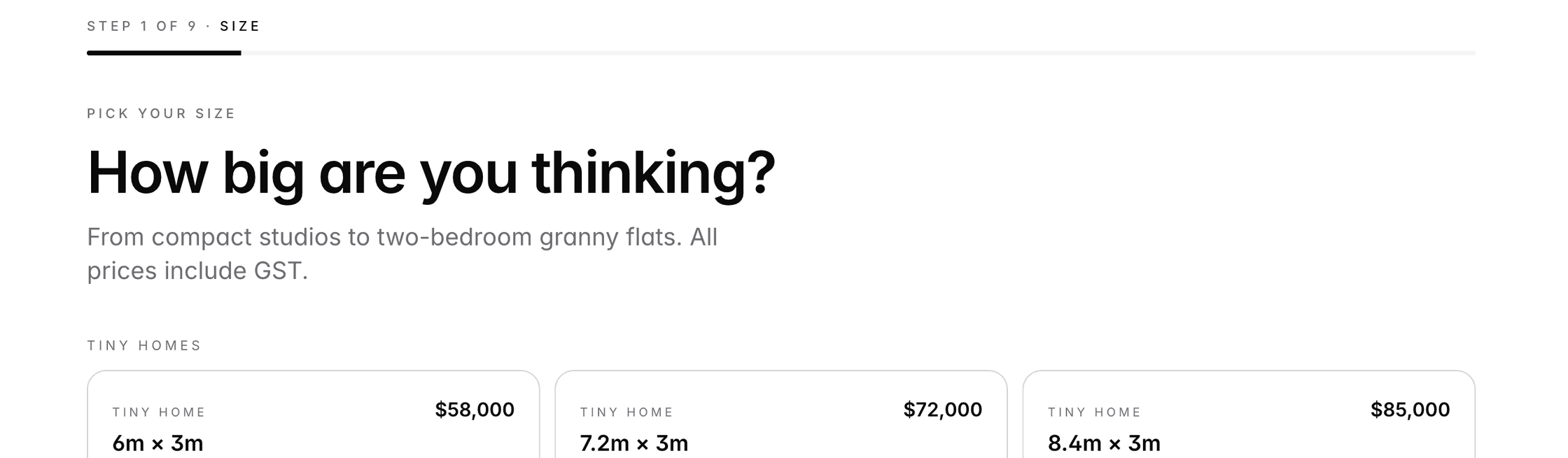
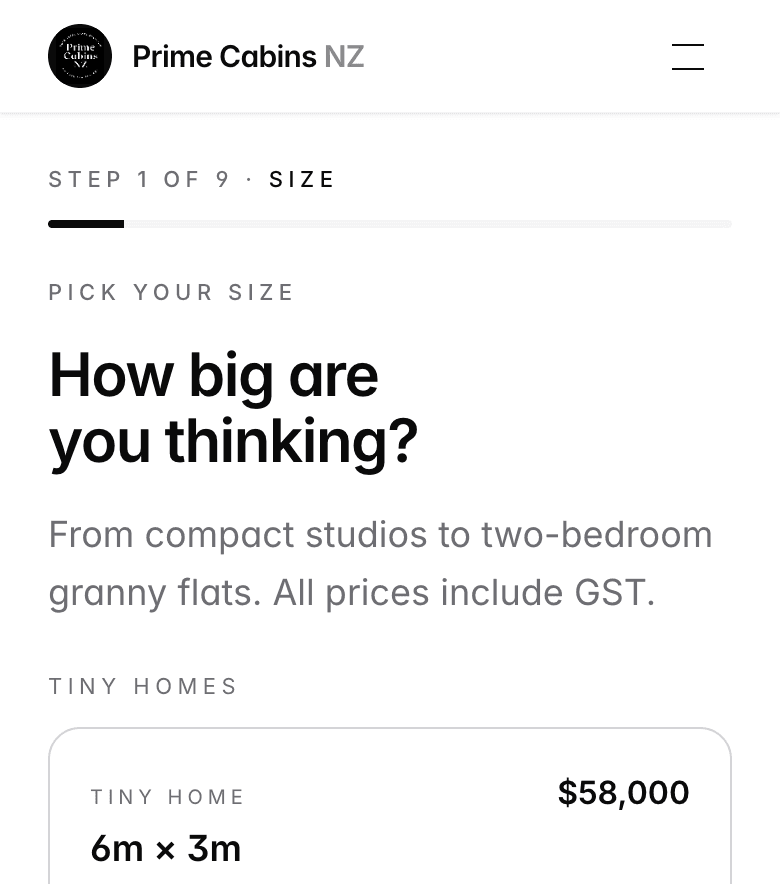
Prime Cabins’ website now answers that question up front. A customer lands on the site, taps “Build a quote”, and configures their cabin across nine steps: the size first, then the configuration, then the options. At the end they see an indicative range, before they’ve given anyone their number.
When they enquire, everything they chose comes with it. The sales team rings them already knowing the job, the budget the customer has seen, and when they want it.
“Customers configure a cabin before they speak to sales. We only talk to people who know what they want and roughly what it costs.”
Turning a price list into nine questions
Here is the part that is genuinely hard, and the part a template can’t do. A price list is written for the people who sell, not the people who buy. It assumes you know what a “7.2 by 3” is and why the ensuite option changes the number. A customer knows none of that. They know they want somewhere for a parent to live, and roughly what they can spend.
So we sat with how Prime Cabins actually prices a cabin and sorted every variable into three piles. Things a customer can sensibly decide online: size, layout, the options with a clear price. Things that move the price but need a human: site access, foundations, delivery distance. And things that don’t move the price at all, which most businesses still ask about anyway.
The first pile became the nine questions. The second became the reason the result is a range, not a quote, and the reason the sales team still has a job. The third was left out entirely. The hardest part of building a calculator isn’t the software. It’s the honesty about what can be priced online, and the discipline to leave the rest to a person.
Why a calculator and not a form
A contact form asks a customer for their details and gives nothing back. Whatever you write on the button, it is a request for a phone call from a stranger. A calculator gives something first: a price, a shape, a sense of whether the thing they want is within reach. It is a better deal for the customer, which is why they use it.
It is also a better deal for the business. The enquiry that arrives already knows its budget, and the conversation that follows starts from “you configured this, let’s talk about the site” instead of “so what were you thinking?”
What’s in place, in one list
- A branded nine-step calculator living on Prime Cabins’ own website
- An indicative range shown before any contact details are asked for
- Every enquiry captured with the customer’s selections attached
- A CRM the sales team works the enquiries from
- Attribution, so they know which ad or channel produced each enquiry
- Ads that send customers to it
Could your business do this?
Prime Cabins sells cabins. You almost certainly sell something else. What transfers is the method: find the handful of choices that decide most of the price, let the customer make them, show a range, and send the enquiry to your sales team already scoped, so they ring the customer knowing the job.
It suits kitchens, decks and pergolas, pools, roofing, landscaping, bathrooms and modular homes: anywhere the price depends on choices the customer can make themselves. It doesn’t suit everything. If we don’t think a calculator makes sense for your business, that is what we’ll tell you.